If AI Writes Code, Where Do Guardrails Live - a Conjecture
Software Engineer - Backend
Guardrails in software engineering are often misunderstood.
Most engineers associate guardrails with:
null checks
validations
defensive coding
That is only a small part of the story.
A more accurate definition is:
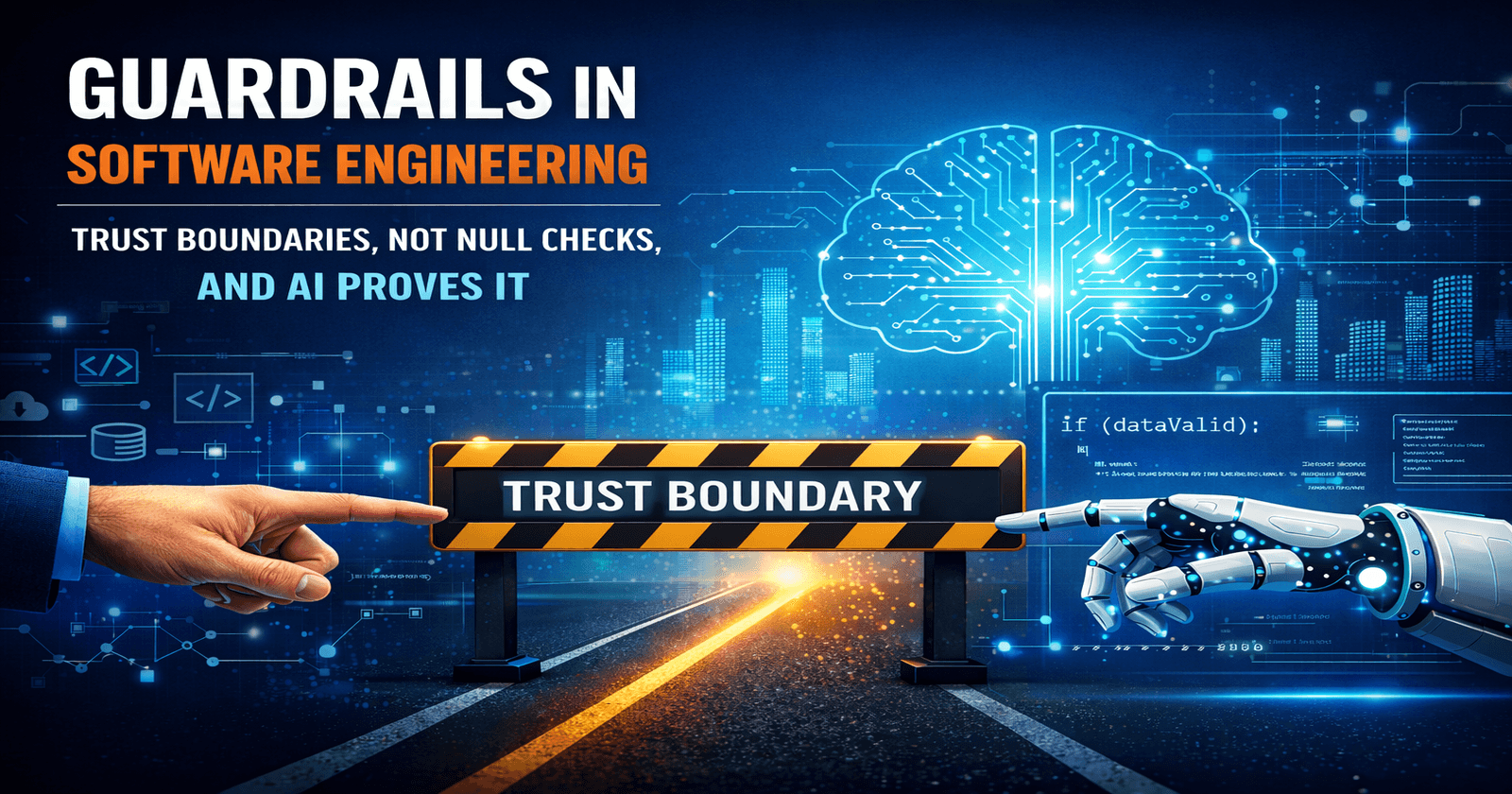
Guardrails are constraints placed at trust boundaries to ensure correctness is preserved.
This definition becomes far more important when we move from human-written systems to AI-assisted systems.
Guardrails Today (Human-written Systems)
In traditional systems, we place guardrails at edges:
HTTP requests
Kafka events
third-party APIs
legacy systems
Why?
Because these are places where:
we lose control over correctness
So we:
validate inputs
enforce invariants
fail fast
Once data crosses this boundary and is accepted:
we treat it as valid
we avoid re-validating deep inside business logic
If you see null checks everywhere inside your core logic:
your boundaries are weak, or
your contracts are unclear
Trust Boundaries (The Core Idea)
The key concept is:
Edges are often at system boundaries, but they really exist wherever you cannot fully trust the data or behavior.
Even inside your codebase:
legacy systems
unclear modules
unsafe dependencies
…are also trust boundaries.
They should be:
isolated
validated at entry
normalized into a clean domain model
Sometimes this isolation is done via an adapter (anti-corruption layer), especially when:
models differ
contracts are unstable
you want to protect your domain
Not always — only when needed.
Enter AI: What Changes?
When AI starts contributing to software development, something fundamental shifts.
AI is not just generating code.
It is increasingly used to:
suggest designs
shape abstractions
influence system structure
So the question is no longer just:
“Is the code correct?”
It becomes:
“Is what we designed and built aligned with what we actually intended?”
The New Trust Boundary
Previously, the primary trust boundaries were:
external inputs
external systems
Now, another boundary emerges:
The gap between what we want to build (intent) and what actually gets designed and built (AI output).
Even if everything “works”, that does not guarantee:
correct abstractions
appropriate boundaries
right level of generalization
This is where subtle but important issues appear.
Validation in AI-driven Systems
Correctness is no longer just about code.
We now validate across layers:
Design against intent
Implementation against design (and intent)
Each layer is checked against the one above it.
This is not entirely new — but it becomes much more critical when:
design is partially generated
implementation is automated
intent is not explicitly captured
Guardrails in AI-driven Development
Guardrails are no longer just about code-level checks.
They exist at multiple levels:
1. Specification Guardrails
Clear definitions of:
requirements
acceptance criteria
invariants
non-goals
Without this:
AI produces plausible but incorrect systems.
2. Design Guardrails
Humans define:
system boundaries
data ownership
API contracts
domain models
AI can assist, but:
it does not reliably choose the right abstractions for your context.
3. Verification Guardrails
Tests and validation become critical:
unit tests
integration tests
contract tests
But beyond tests:
ensuring alignment between intent, design, and implementation becomes essential.
4. Operational Guardrails
At runtime:
monitoring
rate limiting
circuit breakers
feature flags
rollback mechanisms
Because:
failures can propagate faster when systems are generated quickly.
The Role of Humans
There is a common narrative:
“AI will replace software engineers.”
A more grounded view is:
The role of engineers shifts toward defining and enforcing guardrails.
Even today, engineers:
define problems
design systems
decide trade-offs
AI changes how much we implement directly.
It does not remove the need to:
define intent
ensure alignment
validate outcomes
The Deeper Shift
Today:
code is the primary artifact
design is often implicit
With AI:
design and intent need to be explicit
code becomes generated detail
Final Thought
Guardrails are not about who writes code.
They are about where you cannot afford to be wrong.
AI does not remove trust boundaries.
It introduces a new one:
Intent ↔ what gets designed and built
And because of that:
Guardrails become more important, not less.
One-line takeaway
In AI-driven systems, correctness is enforced by validating design and implementation against intent across trust boundaries.